


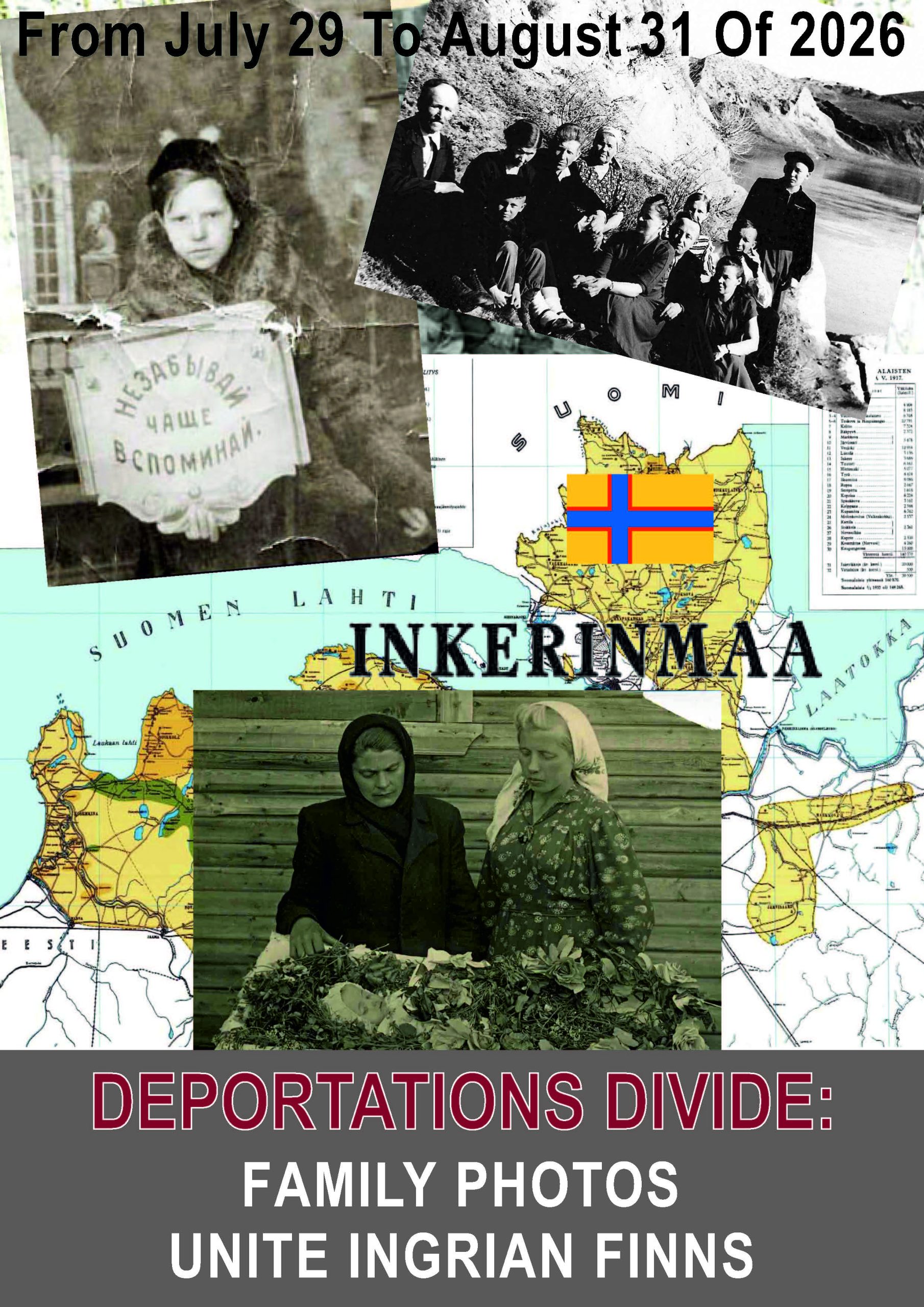
Deportations Divide: Family Photos Unite Ingrian Finns
Main Information
The exhibition will open on July 29 at 3:00 PM. Additional information and registration for the opening: https://www.facebook.com/events/946845241679483
Ingria (Ingermanland) is the name of a region located on the same coast as the Baltic states, around the Neva River, between Estonia and Finland, and between the Baltic Sea and Lake Ladoga.
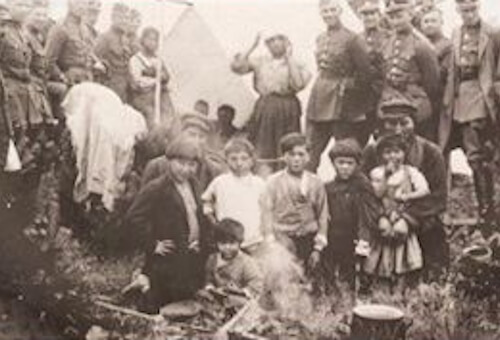
Through photographs and stories, the exhibition reveals the fate of the Ingrian Finns and the history of a those scattered people. The photographs on display have been collected from people living in different countries whose roots reach back to Ingria. For many families, these photographs are the only memories they have of their loved ones. They were taken along during deportations and now, although in tattered condition, the preserved photos still carry with them cherished, as well as painful memories.
In the last century, the Ingrian Finns were subjected to ethnic persecution in the Soviet Union, which ultimately led to their genocide. People were deported from their homeland to distant regions, imprisoned, and sentenced to prison camps. During Stalin’s purges in 1937–1938 and in begining of World War II in 1941–1942, Ingrian Finns were subjected to particularly harsh persecution: families were torn apart, people were executed, and contact with loved ones was severed, often permanently. The deportations took the Ingrians to the steppes of Central Asia, the remote regions of Siberia, and the freezing cold of the Arctic coast, where many perished from hunger, frost, extreme summer heat, and exhaustion from hard labor. This links them with the people of Lithuania, the peoples of the other Baltic countries.
Although more than a hundred years have passed since the beginning of the Finnish-Ingrian dispersal, many of their descendants are still searching for information about their lost relatives. In 1926, there were still around 115,000 Ingrian Finns living in Ingria, but today there are only a handful of Finnish-speaking Ingrians left in the region.
The Ingrian Finns are descendants of Finns who moved to Ingria in the 17th century. They are traditionally Evangelical Lutherans, and their culture and community have been shaped over centuries in Ingria, in the surrounding area of St. Petersburg and at the place of city.
The exhibition, which will take place from July 29 to August 31, 2026, provides insight into the lives, losses, and survival of the Finnish-speaking Ingrians, and reminds us of the effects of history that continue to this day. The current war in Ukraine reflects in many ways the same forced experiences of loss and displacement suffered by Ingrians in the past.
The documentary photos in the exhibition were compiled by Helena Miettinen, PhD, and the awarded collage photos were created by Anni Reuter, PhD. The exhibition in Vilnius is organized by the Inkerin kulttuuriseura ry. (Ingrian Cultural Association) on the initiative and with the active participation of the Ingrian Revival Association and Ingermanland Regional Activity.
Exhibition on Display
Fragments of the Exhibition
Other Exhibitions
 Exhibition
 Exhibition
 Exhibition
 Exhibition
 Exhibition
 Exhibition
 Exhibition
 Exhibition
 Exhibition
 Exhibition
 Exhibition
 Exhibition